Plasma Effect in the Terminal with Golang
One kind of program I’ve always found interesting is the demo: eye-catching graphical effects with code that squeezes every ounce of performance out of the machine. The plasma effect is one of my favorites, simulating a fluid in motion.
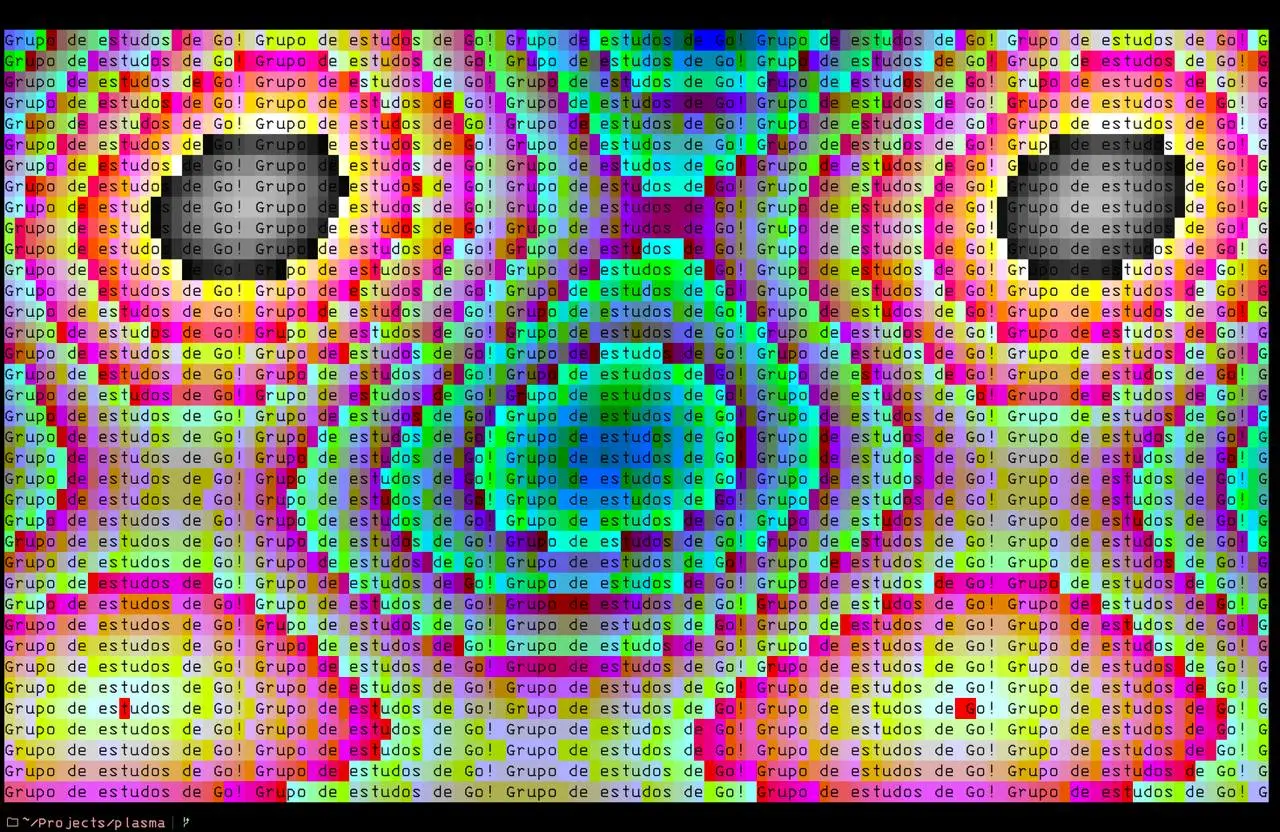
To create the plasma effect, I use several trigonometric functions to calculate the background color of each character, passing time as a parameter to generate the animation. The code is relatively simple, but the optimization is a bit more complex.
Computing these values continuously is very slow, and the terminal isn’t very fast either. To avoid slowdowns that make the terminal output flicker, I precompute some of the calculations.
func precalculateValues(r, c int) {
    preSinX = make([]float64, c)
    preCosX = make([]float64, c)
    preSinY = make([]float64, r)
    preCosY = make([]float64, r)
    preSinXY = make([][]float64, r)
    preCosXY = make([][]float64, r)

    for i := 0; i < r; i++ {
        preSinXY[i] = make([]float64, c)
        preCosXY[i] = make([]float64, c)
    }

    for x := 0; x < c; x++ {
        aX := (float64(x) / float64(c)) * math.Pi * 3
        preSinX[x] = math.Sin(aX)
        preCosX[x] = math.Cos(aX)
    }

    for y := 0; y < r; y++ {
        aY := (float64(y) / float64(r)) * math.Pi * 3
        preSinY[y] = math.Sin(aY)
        preCosY[y] = math.Cos(aY)
        for x := 0; x < c; x++ {
            aXY := ((float64(x) +
                float64(y)) / float64(c)) * math.Pi * 3
            preSinXY[y][x] = math.Sin(aXY)
            preCosXY[y][x] = math.Cos(aXY)
        }
    }
}
Precomputing is only part of the optimization. This code could be faster, but it’s already fast enough without hurting readability.
Another optimization is precomputing the colors. For that, I use the following code:
func precalculateColorStrings() {
    for i := 0; i < 256; i++ {
        colorStrings[i] = "[48;5;" + strconv.Itoa(i) + "m[38;5;0m"
    }
}
This way, we avoid recomputing the same string over and over.
Speaking of strings, another important optimization is sending as much data to the terminal as possible at once. For that, I use the following code, with a preallocated buffer.
bufCap := 20000
buf := make([]byte, 0, bufCap)
This speeds up the program considerably. I left the buffer with a fixed size, but ideally its size would be calculated based on the terminal size. That’s tricky, though, because it’s not enough to multiply height by width; you also have to account for the size of the strings and escape codes. So I just created a buffer large enough.
The complete source code is in the Go Study Group repository.
Video of the program running: