Post-Apocalyptic Computing
Post-apocalyptic computing is a game, an interesting exercise for your imagination. The scenario goes like this: something terrible has happened and the society you live in no longer exists. As a survivor, it’s up to you to help rebuild modern society.
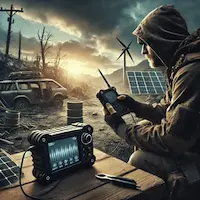
The cause of the apocalypse can be whatever you like: nuclear war, plague, economic collapse, a solar storm, an oppressive government that wants to keep technology to itself, and so on. The only constant is that nothing you take for granted is available. All the infrastructure is gone. There’s no more running water, no electricity, none of the amenities of modern life.
It may seem pointless, but trying to solve problems in a heavily constrained environment forces us to come up with creative solutions. And many of these ideas have practical applications in everyday life, such as building systems that are more efficient yet resilient, with lower power consumption, and so on.
Computing
If you search the internet, you’ll find similar ideas, but under the name post-apocalyptic programming. In my case, I prefer computing because it’s a broader term than just programming.
Challenges
The challenges are many and varied. For example: how to build a small computer that consumes little electricity, how to store and retrieve data efficiently, how to communicate and transfer data, how to keep time and maintain a calendar (essential for agriculture). The list is endless.
There’s an enormous number of considerations to make and ideas to explore. For instance, you could download all of Wikipedia. But now what? How will you store that data safely so it survives the apocalypse? And afterward, how will the data be queried? You can’t rely on your beefy computer, it simply consumes too much power. So you need to research more efficient ways to handle the whole process.
Simplicity and Minimalism
One of the interesting reflections on this topic is cutting out everything that isn’t necessary to meet the project’s goals. Simple and minimalist means fewer things to break, fewer things to go wrong, and ideally a system that can be understood in full by a single person.
The Ideal Computer
In conversations with friends, we tried to define what the ideal computer for post-apocalyptic computing would be. Basically, we arrived at this small set of characteristics.
- It must be portable, as light as possible, ideally less than 1 kg.
- Small in volume, ideally less than a liter.
- Able to be powered easily from a low-voltage, low-current source, something like 5V and 500mAh, so that any hand-crank charger made for cell phones would work.
- Have a battery good for at least an hour of use.
- Have some storage capacity.
- Be programmable on the device itself (you have to be able to write code on it without needing external equipment).
- Have some communication capability, such as IR or perhaps some low-power radio like Bluetooth or LoRa.
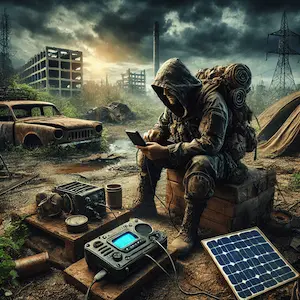
That would be ideal, but it’s hard to find a machine with all these characteristics. My ideas in pursuit of this ideal end up leading me toward microcontrollers, which complicates the software side because of the Harvard architecture. But it’s precisely these difficulties that make the game interesting.
Conclusion
Thinking about post-apocalyptic computing teaches us that, when all else fails, we can still rely on human creativity to find solutions. And that often less is more, and that simplicity and minimalism are virtues worth cultivating.
And good luck rebuilding civilization!